
Why Four Countries' Procurement Managers Still Choose China: A Cost-Benefit Analysis
As the founder of ProMfg Hub, a manufacturing solution provider based in Suzhou, I spend my days helping overseas buyers navigate the complexities of sourcing from China. This article is a summary of what I've observed — the real math and real concerns that procurement managers in four key markets face when they choose China.
Imagine you're a procurement manager at a mid-sized medical device company in the U.S. Your team is about to launch a portable ultrasound device. It involves an injection-molded housing, a PCB motherboard, a precision metal probe, a battery pack, a display, and connector cables — a dozen parts, spanning four or five different manufacturing processes.
You have two options: find a factory in the U.S., or source from China.
U.S. manufacturing means easier communication, controlled quality, no ocean freight risk. But at what cost?
Chinese sourcing means language barriers, shipping volatility, quality concerns. But what's the upside?
This isn't a simple choice. I spent time studying how procurement decision-makers in four different markets answer this question. Here's what I found.
The U.S. Procurement Manager's Math: Tariffs vs. Cost
U.S. procurement managers hear this question constantly: "With tariffs, why still buy from China?"
The answer: tariffs hurt, but U.S. manufacturing hurts more.
Morgan Stanley calculated in a 2025 research note that even with a 25% tariff on iPhone imports, Apple is unlikely to move production back to America. Why? Because manufacturing an iPhone in the U.S. would cost 35% more than in China or India. An iPhone 16 Pro would need to retail at $1,350 instead of $999 to maintain the same margin.
The core gap? Labor. U.S. hourly labor costs are 4.5 times China's. Worse, Chinese manufacturing workers are on average 2.4 times more efficient. U.S. private-sector total hourly compensation is about $56, while Chinese manufacturing wages range from $2.6 to $5 per hour.
Bottom line: U.S. manufacturing costs are on average 50% higher than China's. A $10,000 order from China might cost $15,000 or more domestically.
But U.S. procurement managers worry about more than money.
Concern one: quality consistency. Will the first batch be good and the second batch problematic? This concern has a basis, but it's shifting. Chinese auto parts are flooding into Germany, with Chinese companies closing the quality gap through R&D and production line upgrades.
Concern two: intellectual property protection. This is a legitimate fear. But it can be managed through NDAs, split orders across factories, and working with reputable intermediaries.
Concern three: supply chain transparency. U.S. buyers have widely adopted a "China + 1" diversification strategy. But the latest round of tariffs makes "+1" hard — Vietnam, Thailand, and other Southeast Asian countries are also hit with 36%-46% tariffs.
Here's the telling number: despite all these concerns, two-thirds of companies plan to maintain or expand their China business in 2025. The math simply works.
The German Procurement Manager's Math: The World's Highest Labor Costs
Germany's situation is even more extreme.
A study by Oliver Wyman shows that German automakers spend an average of $3,300 per vehicle on labor alone — including wages, pensions, and benefits. In China, that number is $585. Germany is 5.5 times more expensive. Some vehicle models cost up to $7,800 more to produce in Germany than in China.
Material costs in Germany are also 60% higher. The total manufacturing cost per vehicle exceeds €4,000 — 40% more than in China.
German procurement managers worry about quality certifications and political pressure. The German Vice Chancellor publicly expressed frustration over Deutsche Bahn's purchase of Chinese electric buses. Domestic auto production has dropped by over a quarter in the past decade.
But Chinese auto parts keep coming — at competitive prices, with improving quality, across electrical systems, forged metal components, and more. Industry associations warn that without decisive action, European component manufacturing faces relocation or bankruptcy.
The German procurement manager's conclusion: it's not about wanting to buy from China. It's about whether you can afford not to.
The Israeli Procurement Manager's Math: No Choice
Israel's situation is different. The problem isn't high costs — it's that there's often no domestic alternative at all.
Israel lacks a complete industrial system. Critical raw materials are almost entirely imported. Take aluminum profiles — essential for construction — primarily imported from China. In 2025, Israel considered imposing 61%-146% provisional anti-dumping duties on Chinese aluminum. The result? Imports halved, from $19.5 million in January to $9.3 million by June.
Israeli procurement managers worry about supply stability amid escalating Middle East conflicts, compliance risks, and quality demands. But the numbers speak: from January to April 2025, Israel's imports from China totaled $4.43 billion — a 31.45% year-on-year increase. The growth is accelerating.
The Middle Eastern Procurement Manager's Math: Money, But No Supply Chain
Middle Eastern countries — Saudi Arabia and the UAE in particular — share a similar problem with Israel. They have the money and the projects, but not the manufacturing base.
The region's manufacturing foundation is thin. Electronic components, mechanical parts, and other core materials must be imported from China or elsewhere. In 2025, the Middle East accounted for about 14% of China's total steel exports.
Middle Eastern procurement managers worry about price sensitivity, geopolitical risks in the Strait of Hormuz, and localization pressure from Saudi Vision 2030. But China's role in the region's supply chain is irreplaceable in the near term.
What This All Means
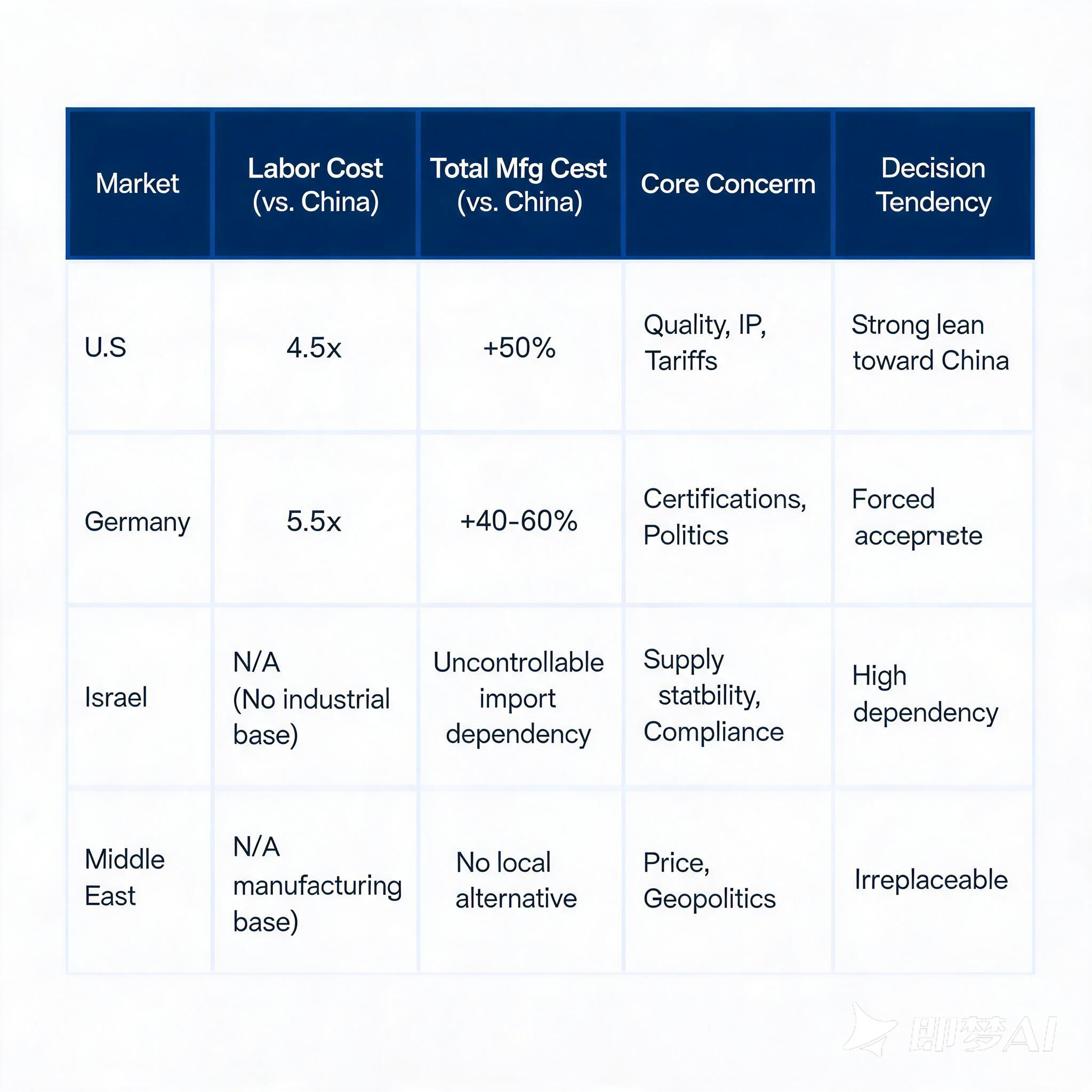
The table below summarizes the key findings across the four markets:
U.S.: Labor cost 4.5x higher, total mfg cost +50%, core concerns are quality, IP, and tariffs. Decision tendency: strong lean toward China.
Germany: Labor cost 5.5x higher, total mfg cost +40-60%, core concerns are certifications and politics. Decision tendency: forced acceptance.
Israel: No industrial base, uncontrollable import dependency, core concerns are supply stability and compliance. Decision tendency: high dependency.
Middle East: No manufacturing base, no local alternative, core concerns are price and geopolitics. Decision tendency: irreplaceable.
A Final Thought from a China-Based Manufacturing Connector
I didn't write this to argue that Chinese manufacturing is unbeatable. I wrote it to share a real observation: China's supply chain advantage isn't "cheapness." It's completeness.
America has the technology. Germany has the engineering precision. Israel has the innovation. The Middle East has the capital. But no single country can deliver a complex project — with a dozen different parts across five different processes — in eight to ten weeks.
Procurement managers do the math and find: the total cost of a project in China — including freight, tariffs, and your service fee — is still 30%-50% cheaper than doing it domestically. The savings alone pay for multiple rounds of ocean freight.
This isn't a story about "China replacing anyone." It's a story about global specialization. Every country does what it does best. The procurement manager's job is to find the optimal solution globally.
My job is to help them find it — and make the process a lot less painful.
If you're a procurement manager or engineer evaluating whether to source precision parts or cleanroom components from China, I'm happy to talk through your specific project. No pitch, just practical advice based on what I see on the ground in Suzhou every day.
WhatsApp: +86 18112360404
Email: contact@mfgprohub.com
Website: https://www.mfgprohub.com
About the author: Ziqian Hu is the founder of ProMfg Hub, a Suzhou-based manufacturing solution provider. He helps overseas buyers navigate CNC precision machining and cleanroom engineering projects in China.
Connect with Ziqian on LinkedIn | Read more insights on Medium